

AI, Asparagus, and Asking Better Questions: Reflections from EuroSense 2026
I just returned from EuroSense 2026 in Norway, and as I started thinking about what I wanted to say about the conference, I realized I didn't really want to write a recap.
There were four days of talks, posters, workshops, conversations, and more sensory science than I could possibly summarize in one blog post. I also had a pretty full schedule myself: a presentation on palate cleansing with Stella Salisu and Tian Yu, a poster on Behavioral Topic Mapping with Tian, and an early-morning AI workshop with Aigora.
But when I thought about what actually stayed with me after the conference, one thing was impossible to ignore.
There was a lot of AI.
A lot of AI.
AI for analyzing qualitative research. AI for analyzing open-ended responses. AI-generated images. AI-assisted scientific writing. Synthetic consumers. Digital twins. AI tools for seemingly every part of the research process.
And somewhere around day three, I started to feel a little…AI fatigued.
Not because I don't use AI. Quite the opposite. I'm actively exploring how AI can help us do new kinds of research. But sitting through so many conversations about AI made me start asking a slightly different question:
Are we using these tools to help us do better science, or are the tools starting to become the story?
The pressure to go faster
One thing I heard repeatedly at EuroSense, particularly in conversations with research vendors, was the pressure coming from clients to do research faster and cheaper.
In fact, at the end of one of session on AI use, the panel of speakers sat ready for questions and David Thomson of MMR commented that there is immense pressure for vendors to do more with less and faster and really questioned what the panel thought this may be doing to the quality of work.
That's not exactly new. Anyone who has worked in industry research has heard some version of “Can we do it faster?” or “Can we do it with a smaller budget?”
But AI changes what is possible, and perhaps what is expected.
If an AI tool can code hundreds of open-ended responses in minutes, why pay people to do it? If synthetic consumers can provide early feedback on concepts, why recruit humans? If an AI chatbot can conduct an interview, summarize it, make the slides and perhaps even help you present them, where exactly do we still need the researcher?
Those are intentionally provocative questions. The panel didn’t exactly offer any answers, just acknowledgement that yes, many of these tools have enormous potential.
But speed and cost are operational benefits. They aren't necessarily scientific benefits.
Sometimes the slow parts of research are where the thinking happens. And sometimes slowing down is intentional.
Our Behavioral Topic Mapping work, for example, uses AI to help work through tens of thousands of pieces of naturally occurring consumer language. But BTM isn't actually particularly fast. Tian and I have deliberately built brakes into the process.
The AI helps us see patterns at a scale that would be extraordinarily difficult to see manually. But then we slow down. We interrogate those patterns. We go back to the consumer language. We apply behavioral frameworks. We question interpretations.
And, perhaps most importantly, we're not asking AI to tell us what consumers think.
We're trying to use it to identify better questions for R&D and innovation to investigate next.
That distinction generated some really interesting conversations around our poster. Once people understood what we were trying to accomplish, there was a lot of enthusiasm, particularly around the behavioral frameworks. But the initial assumption was often that AI + consumer language = an automated way to generate consumer insights.
That made me wonder whether we've become so accustomed to thinking about AI as an answer machine that we're overlooking another potentially powerful role for it.
What if one of the best uses of AI in research is helping us ask better questions?
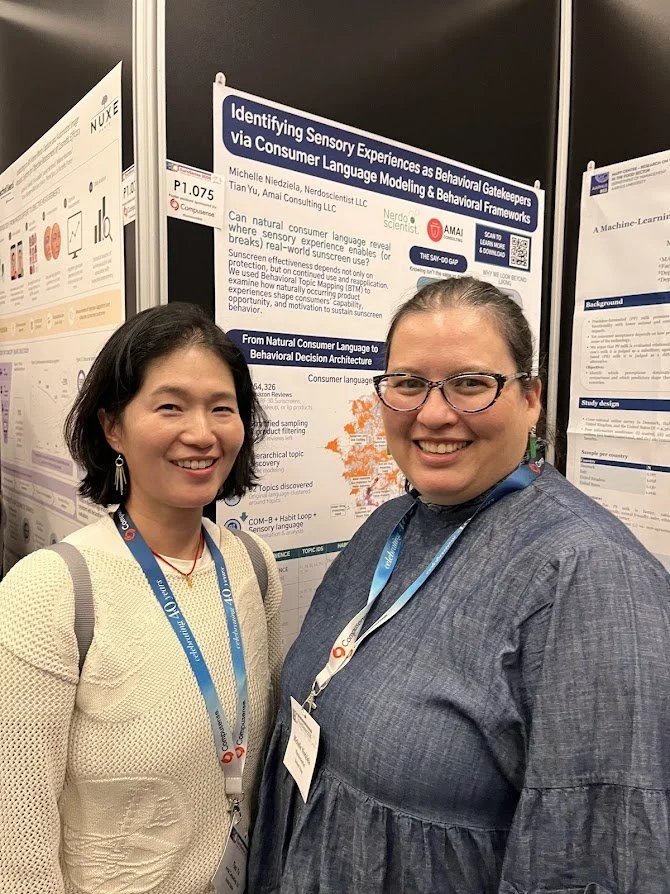
Tian and I in front of our poster during Poster Session 1
The asparagus method
I conducted a tiny (and decidedly nonscientific) experiment of my own during the conference.
I participated in an AI workshop organized by Aigora, where several of us working with AI moderated table discussions with conference attendees. The conversations were recorded and uploaded, and AI was then used to synthesize what had been discussed across the tables.
My table had a fascinating conversation about what we called the AI “haves and have-nots.”
Some researchers have broad access to AI tools and work in organizations encouraging them to experiment. Others have limited or no access because of company policies, privacy concerns, resources, or infrastructure.
As some teams move full steam ahead, what happens to the people who can't?
Will they be perceived as slower? Less innovative? Less productive?
Toward the end of our discussion, though, I decided to mess with the experiment a little because that’s just the kind of silly little nerdoscientist I am.
I introduced an entirely fictional AI technique I called the asparagus method.
[UPDATE: John reports that the asparagus method did show up in the notes! This is great news. But a reminder that it up to the researcher to make sure to dig in themselves as well as use AI as a tool to summarize. It was in the notes, but what does that mean in the larger pictures of AI filtering and summarizing?]
I asked everyone at the table to talk for a few minutes about how amazing and useful the asparagus method was.
We did.
And then we waited for the AI-generated summary.
And… no asparagus.
Later, I told John Ennis from Aigora what we had done. He searched through the notes available to him.
Still no asparagus.
Now, I have absolutely no intention of drawing a scientific conclusion from this. Maybe the AI recognized that we were gaming the exercise. Maybe the discussion was too brief to make the summary. Maybe it was deemed irrelevant. Maybe something else happened entirely.
But that's exactly what made it interesting.
If I hadn't been in the room, how would I know something was missing?
The resulting summary could still be perfectly useful. But a summary is inherently a reduction of what happened. When AI performs that reduction for us, we need to remember that decisions are being made about what matters.
The output can look complete even when something has disappeared.
Apparently, sometimes even asparagus.
A voice from sensory conferences past
All of this kept reminding me of something that happened at the Society of Sensory Professionals meeting in Savannah in 2022.
During a panel discussion, people were talking about the new skills sensory scientists needed to develop. At the time, the shiny new things weren't generative AI. They were things like R, programming, data science and an expanding set of business and management skills.
Gail Vance Civille of Sensory Spectrum stood up and essentially scolded the room a bit.
Her message, at least as I remember receiving it, was: Don't forget the sensory science.
It stuck with me.
Two years later, when I was Scientific Chair on the SSP Executive Committee and co-chairing the scientific program for the Pittsburgh meeting, I found myself thinking about Gail's comment as we worked on the program. Were we balancing the new methods and emerging topics with psychophysics, perception, individual differences, statistics, methodology and the fundamentals of what sensory scientists actually do?
Conference organization is hard, and I certainly don't claim we got that balance any more “right” than anyone else.
And to be fair, I suspect Gail's position might be somewhat different today too. Sensory Spectrum, like everyone else, is navigating a rapidly changing research environment. Staying relevant does require innovation. Sensory scientists should learn about AI. We should borrow from psychology, behavioral science, neuroscience, data science and other disciplines.
But I still think the Gail of 2022 was onto something.
And I wonder what she would have thought about EuroSense 2026.
Flashy isn't always better science
This is also a fight I've been having much longer than generative AI has existed.
I came into consumer research through neuroscience, and I've watched sophisticated technologies get sold with much simpler stories about what they supposedly tell us.
GSR measures “emotion.”
EEG tells us what consumers “really” feel.
Eye tracking tells us what someone cares about.
Except…not exactly.
At EuroSense, there were still presentations using GSR as an emotion measure. During one discussion involving cephalic-phase feeding responses, I pointed out that GSR is fundamentally an autonomic nervous system measure. In a context where you're specifically studying physiological preparation for feeding, changes in autonomic activity may have interpretations that have very little to do with an emotional response.
Several people approached me afterward to say they were glad I'd raised it. And that's one reason I ask a lot of questions at conferences. Not to be difficult, but because scientific discussion should include questioning what our measures actually mean.
AI doesn't create that problem. It is simply the newest version of it.
A sophisticated tool does not automatically produce a sophisticated inference.
I worry that we've seen this movie before. Neuromarketing provides a useful cautionary example of what can happen when excitement around technology moves faster than our understanding (or our communication)of what those measures can actually tell us.
Maybe AI gives us an opportunity not to repeat that mistake.
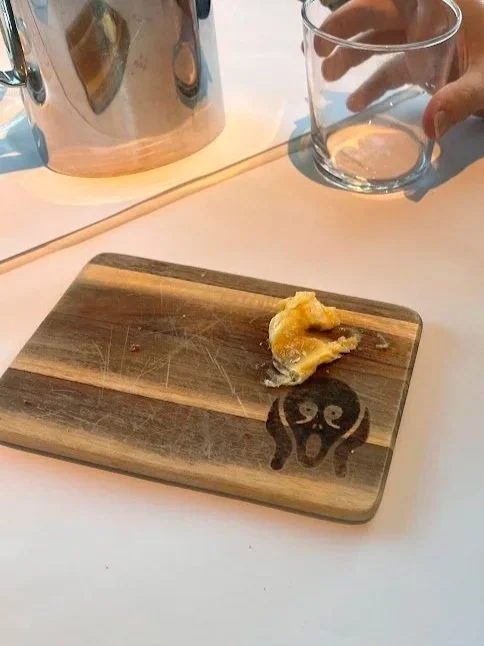
Bread (already eaten) and butter board with our dinner at the Munch Museum.
Sometimes the refreshing research isn't flashy at all
Ironically, one of my favorite experiences at EuroSense involved something signficantly less futuristic:
Palate cleansers.
Stella delivered our talk, “Between Bites: What Really Works in Palate Cleansing?”, based on our survey of sensory professionals and our review of the scientific literature.
One of the clearest examples from our work involves spicy products. The literature suggests that water isn't particularly effective for reducing the effects of capsaicin. Yet our survey shows that sensory professionals still commonly use water when evaluating spicy products.
Our conclusion wasn't that everyone is doing it wrong.
It was that there isn't one universally correct palate cleanser.
What are you trying to clear? What is the risk of carryover? How important is discrimination between samples? What is feasible within your study? And crucially: how do you know your cleanser worked?
After the talk, several people came up to tell us what they use in their own work. One person explained that he uses sweetened water for spicy samples and asks panelists to check whether they feel clear before proceeding.
Is sweetened water the scientifically optimal cleanser for his particular application?
I don't know.
But he's checking.
And that was largely our point.
People described the talk as “refreshing”, a particularly appropriate compliment for a presentation about palate cleansing, and quite a few followed the QR code to dig further into our data.
In the middle of all the conversations about new technology, there was apparently still plenty of appetite for a basic sensory question:
Does the thing we're doing actually work?
Maybe that's not so different from my asparagus experiment after all.
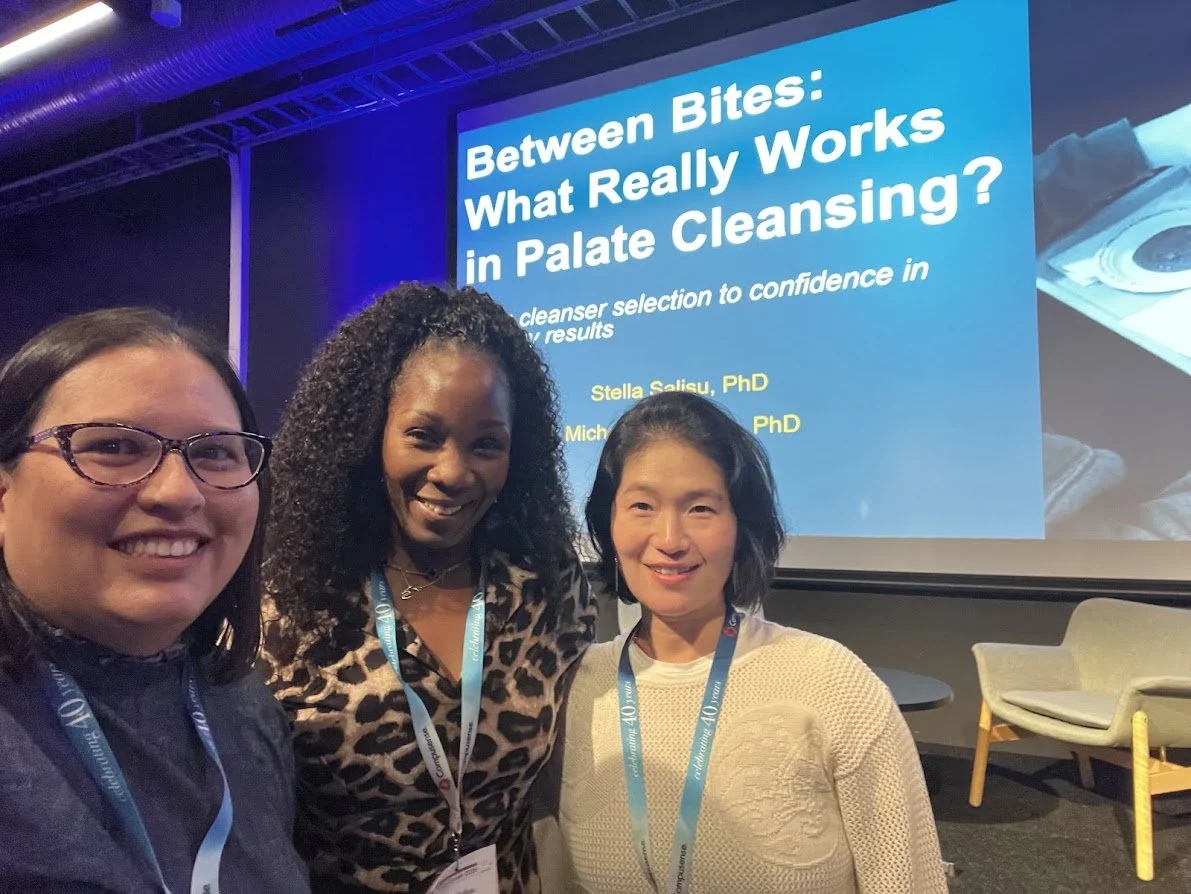
Myself, Stella, and Tian just before Stella’s delivery of our presentation.
Expanding sensory science, not replacing it
I don't want this to sound like I spent four days in Norway grumbling every time someone said “AI.”
I didn't.
There was great sensory science at EuroSense.
Thomas Hummel spoke about olfactory function, and I could listen to him talk about smell and perception for hours. There was fascinating work on communicating tactile properties in online retail. And EuroSense continues to provide more space than many conferences for sensory research outside the traditional food-and-fragrance domains.
That's something I genuinely love about this meeting.
Sensory science shouldn't get smaller.
I want us studying texture. Clothing. Shoes. Sound. Digital experiences. Personal care. Food. Fragrance. Crossmodal perception. Sustainability. New materials. New technologies. New behaviors.
I want us borrowing from psychology, neuroscience, behavioral science and data science.
And yes, I want us using AI.
But I want those things to expand what we can discover, not distract us from why we're doing the research in the first place.
One presentation captured that tension particularly well for me. Lise Dreyfuss was discussing digital twins, but rather than simply celebrating another technological opportunity, she questioned what we mean when we try to digitally replicate people.
And then she brought her actual twin onstage.
In a conference full of digital humans, an actual human twin was one of the AI moments I remembered most.
There is probably a lesson in that.
Maybe the most important sessions happened in the hallway
For all my thinking about the scientific program, some of the most valuable parts of EuroSense weren't on the program at all.
They were the hallway conversations.
I caught up with Ellie and heard about her adventures moving from New Jersey to the Netherlands for her new role at MMR. I heard about changes in Jenn's role as her organization and teams evolve. I got to know Ewelina better as we explored Oslo together after we failed to get tickets to the conference gala.
And Tian and I had the kind of long conversations we always seem to have, about research, history, philosophy, culture and just about everything else, but this time we got to have them in person.
I felt surprisingly relaxed at this EuroSense despite having a workshop, presentation and poster on my schedule. There seemed to be time to linger. To talk. To ask another question.
As an independent consultant, I could call that “networking,” and certainly relationships are an important part of why I attend conferences.
But networking doesn't quite capture it.
Science is social.
Ideas develop through conversation. Someone asks a question you hadn't considered. Someone challenges your interpretation. Someone tells you about a completely different application. Someone mentions what their company is struggling with. Someone tells you what they're excited about.
And sometimes you just get on a boat together and explore Norway.
Those conversations help me understand where the field is going every bit as much as the formal presentations do.
No gala, no problem. Ewelina, myself, Tian, Stella, and Jessi ride the public water transit ferry at sunset.
These tools are great. So are we.
I came home from EuroSense both excited and concerned.
I'm excited because we've never had access to more interesting tools for understanding how people experience the world around them. We can work with quantities of language and data that would have been unimaginable earlier in my career. We can combine methods and ideas from disciplines that once rarely spoke to one another.
I'm concerned because sometimes I think we're skipping steps, losing track of the fundamentals of understanding very human behaviors.
Recently, I saw a journalist put a line into a Qwoted request asking respondents not to use AI:
“We're better than that.”
It made me laugh.
But I've thought about it several times since.
I wouldn't go quite that far.
Use AI.
Experiment with it. Learn what it can do. Let it make parts of our work faster. Use it creatively to discover things we couldn't have discovered before.
These tools are great. But so are we.
Don't hand over the thinking just because something can think alongside you.
Start with the research goal, not the method.
Understand what your measures actually measure.
Check the output.
Question the interpretation.
Ask whether something is missing.
And occasionally invent an asparagus method just to see what happens. Always check.
One of the things I enjoyed about EuroSense was hearing some of the history of Norwegian sensory science alongside all this discussion of where the field is going next. The tools available to those early sensory panels and the tools we're discussing today could hardly look more different.
But the thing that makes sensory science fascinating hasn't really changed.
We get to discover new things about how people experience the world around them.
That's still pretty cool.
Keep the Conversation Going
The best research doesn't start with the newest tool. It starts with the right question. If your team is thinking about how AI, behavioral science, neuroscience, sensory methods, or some combination of them, can help you answer better questions, I'd love to talk.
Whether you're evaluating a new research tool, rethinking an existing approach, or trying to figure out what you should be measuring in the first place, let's set up a conversation. Sometimes the most useful first step is simply slowing down long enough to ask, What are we actually trying to learn?
