

Different Methods, Different Minds: What Happens When Consumers Don’t Have Time to Think?
Implicit methods have an appealing promise.
Ask consumers what they think about a product and you get one kind of answer. But make it harder for them to deliberate, edit, rationalize, or construct that answer, and perhaps you can get closer to associations that are more immediate or readily accessible.
In commercial consumer research, that promise has sometimes been simplified even further: explicit measures tell us what consumers say, while implicit measures somehow tell us what they really think or feel.
I've never been particularly comfortable with that distinction.
And after working through the results of a study we originally presented at the 16th Pangborn Sensory Science Symposium, and revisiting those data for the Society of Sensory Professionals meeting, I'm even less convinced that "say versus feel" or "explicit versus deeper" is the most useful way to think about these methods.
The data suggest a more interesting question:
What changes when we change the conditions under which consumers are asked to respond?
And perhaps just as importantly:
Does that change depend on the consumer doing the responding?
And this time, we took a fresh perspective to deliver at the 2026 SSP (Society for Sensory Professionals) Conference.
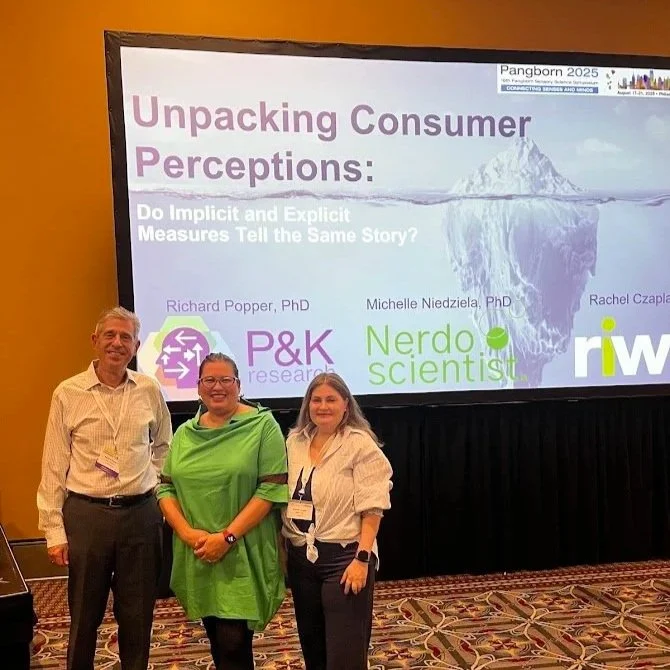
Richard Popper, myself, and Rachel Czapla at our Pangborn2025 presentation.
Comparing the same products through different measurement lenses
Our original study was designed to be intentionally more applied than academic. We wanted to compare methods in a way that resembled how consumer researchers might actually use them commercially.
Consumers evaluated three familiar lip product formats: matte lipstick, glossy lipstick, and lip balm. We examined three different kinds of product associations:
Descriptive attributes: what the product is like
Functional attributes: what the product does
Emotional attributes: how the product may make someone feel or what it may communicate
And we compared three measurement approaches.
Two were traditional explicit approaches: Check-All-That-Apply (CATA) and 7-point rating scales. The third was the Implicit Selection Test (IST), a reaction-time constrained associative task in which consumers had limited time to respond to product-attribute pairings.
The IST is commonly described as an "implicit" approach (see my previous blog post for my thoughts on this here), but that term needs some care. In this case we used RIWI’s version of implicit measurement. Many vendors selling implicit methods simply add a timer to participant responses. But the RIWI IST method, based on my design from HCD’s approach (described here in this old vidcast of mine and in this old HCD demo), based off of the original academic Implicit Association Test (see Harvard’s Project Implicit for example and more discussion). Participants know what they are looking at and know that they are responding. And in the RIWI/HCD design, we included a priming/training period to participants stressed about constrained timing (less than 800ms to respond) and a fear of getting their answer incorrect. Only measuring reaction time is not the same. However, this still is not exactly a direct window into an unconscious mind. It’s a measure of strength of mental association.
A more useful way to describe what we manipulated in our current study is opportunity for deliberation.
With CATA and ratings, consumers have time to evaluate an attribute, consider the product, and decide whether, or how strongly, it applies. With IST, that opportunity is constrained. Responses therefore tell us something about which associations are accessible under those conditions.
That distinction became important once we looked at the results.
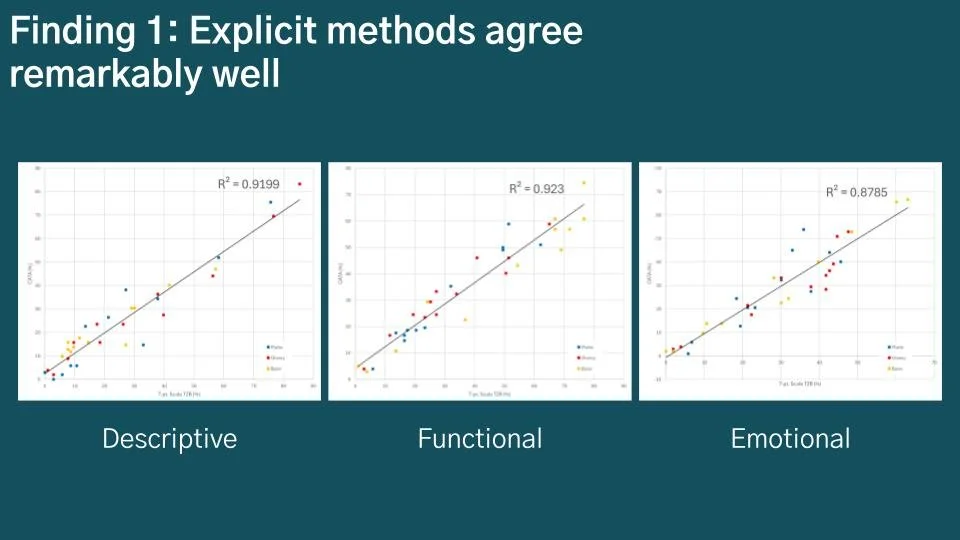
Explicit measures largely told the same story
One of the clearest findings was just how strongly the two explicit approaches agreed.
Across descriptive, functional, and emotional attributes, CATA and top-two-box rating responses were highly correlated. The R² values were approximately .92 for descriptive attributes, .92 for functional attributes, and .88 for emotional attributes.
Changing the explicit response format therefore did relatively little to change the overall product story.
Consumers differentiated matte lipstick, gloss, and balm in ways that made intuitive sense. Matte was associated with attributes such as matte and mattifying. Gloss was glossy and shiny. Balm carried functional associations such as moisturizing, softening, protective, and nourishing.
Then we looked at IST.
And the story changed.
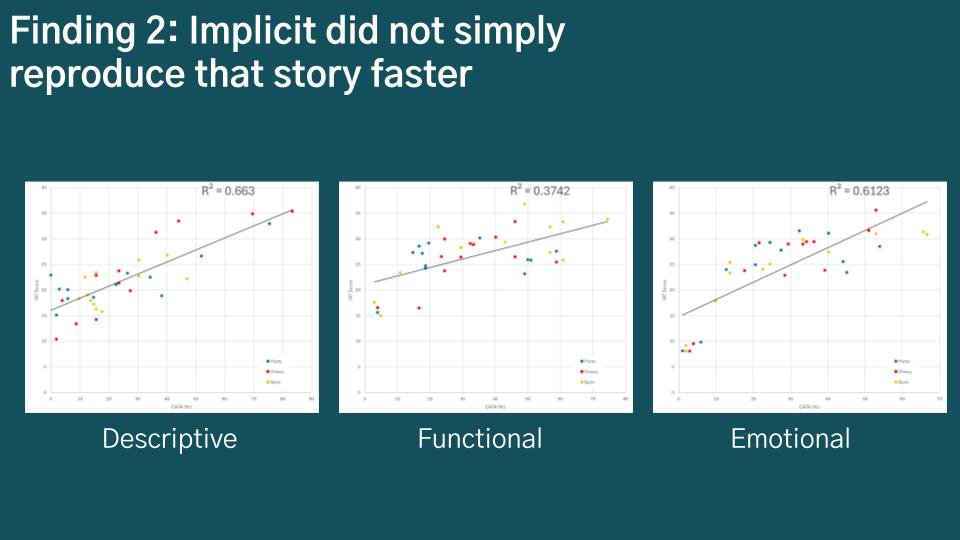
from SSP2026 presentation
IST wasn't simply CATA with a stopwatch
The relationship between CATA and IST was much weaker: approximately R²=.66 for descriptive attributes, .37 for functional attributes, and .61 for emotional attributes.
More importantly, the difference wasn't simply that consumers made the same distinctions to a lesser degree.
The pattern of differentiation changed.
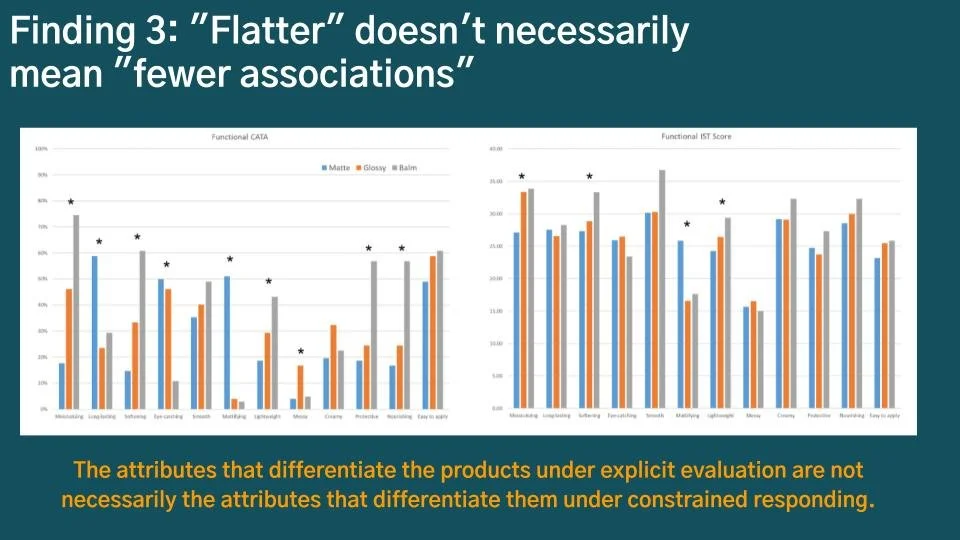
Consider the functional attributes. Under CATA, many attributes significantly differentiated the three product formats. Consumers distinguished the products on associations such as mattifying, long-lasting, softening, moisturizing, lightweight, protective, and nourishing.
Under the time-constrained IST, substantially fewer of those product differences emerged.
So asking consumers to respond rapidly didn't simply give us the explicit profile faster.
It changed the profile we observed.
That distinction matters.
If IST were simply a faster version of explicit measurement, we would expect roughly the same peaks and valleys compressed onto a different scale. Instead, some associations persisted, others became much less differentiated, and the relative prominence of some attributes changed.
But there are several possible explanations for that.
Perhaps IST is less sensitive to some product distinctions.
Perhaps explicit evaluation creates or amplifies differentiation because consumers have time to retrieve product knowledge, compare attributes, and construct a more discriminating judgment.
Or perhaps the methods are sensitive to somewhat different aspects of the evaluation process.
Our study cannot distinguish definitively among those explanations.
And I think acknowledging that uncertainty is more useful than simply deciding that one method is "better."
from SSP2026
What does a flatter implicit profile actually mean?
When we first presented these findings, one of the words we used frequently was flatter.
That's descriptively true. Compared with CATA and ratings, IST often produced less contrast among attributes and fewer statistically significant differences among product formats.
But I've become much more cautious about what we infer from that flatness.
A flatter profile does not necessarily mean there are fewer associations.
Nor does it mean IST has filtered away all the weak associations and uncovered a small set of "true" ones.
In fact, consumers often responded positively to many associations in IST. What was reduced was the relative differentiation among them.
That leads to a much more interesting theoretical question:
Is constrained responding reducing our sensitivity to product differences, or is reflective evaluation amplifying those differences through retrieval, comparison, and deliberation?
Potentially, both processes are contributing.
And that makes convergence between methods just as interesting as divergence.
Where the methods agree, and where they don't
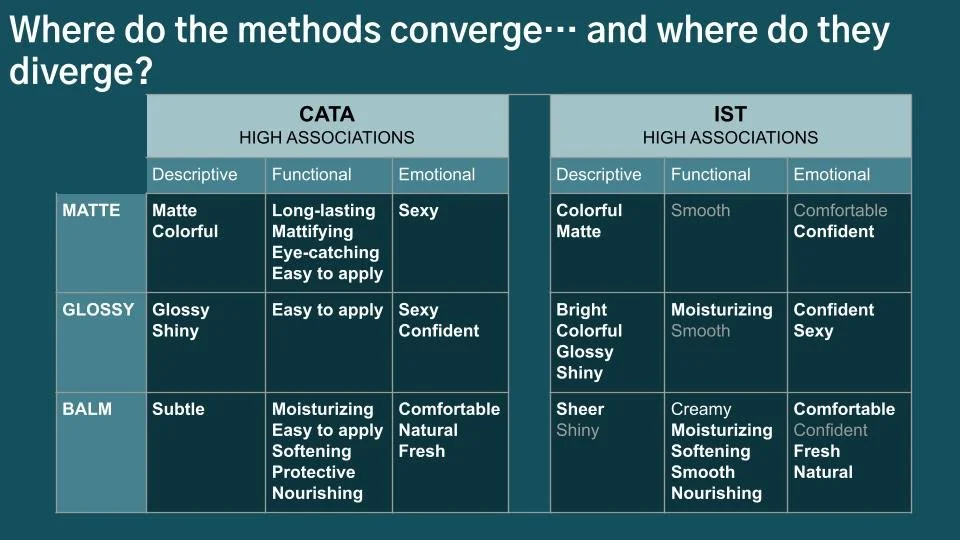
When we summarized the strongest associations from CATA and IST, there were clear points of agreement.
Matte lipstick was strongly associated with matte across methods. Gloss retained glossy and shiny associations. Balm retained several associations related to moisturizing, comfort, and naturalness.
Those associations appear relatively robust to very different response conditions.
But there were also interesting disagreements.
Attributes that were prominent explicitly did not always rise to the top under IST. Conversely, some associations were relatively prominent under constrained responding despite being less dominant in the explicit profiles.
It's tempting to look at those disagreements and say:
"Aha! The implicit measure found what consumers really think."
But our data don't justify that conclusion.
Without an external criterion, choice, purchase, usage, persistence, or another meaningful behavioral outcome, we don't know which response is more consequential.
Instead, I think divergence gives us a hypothesis.
If an association is strongly endorsed when consumers have time to reflect but is much less prominent under constrained responding, perhaps deliberation or comparison contributes to that association.
If an association emerges rapidly but isn't strongly endorsed explicitly, perhaps it is readily accessible but becomes less important once the consumer has time to evaluate it.
Or perhaps we're seeing differences in measurement sensitivity.
Those possibilities require further testing.
Different does not automatically mean deeper. But different may still matter.
from SSP2026
What about emotion?
This was another place where our findings challenged our original thinking.
Implicit methodologies are frequently discussed in commercial research in connection with emotion. There's an intuitive logic behind that association: emotions can occur rapidly, so perhaps rapid-response measures should be particularly good at revealing emotional product associations.
We included that idea in our original hypotheses.
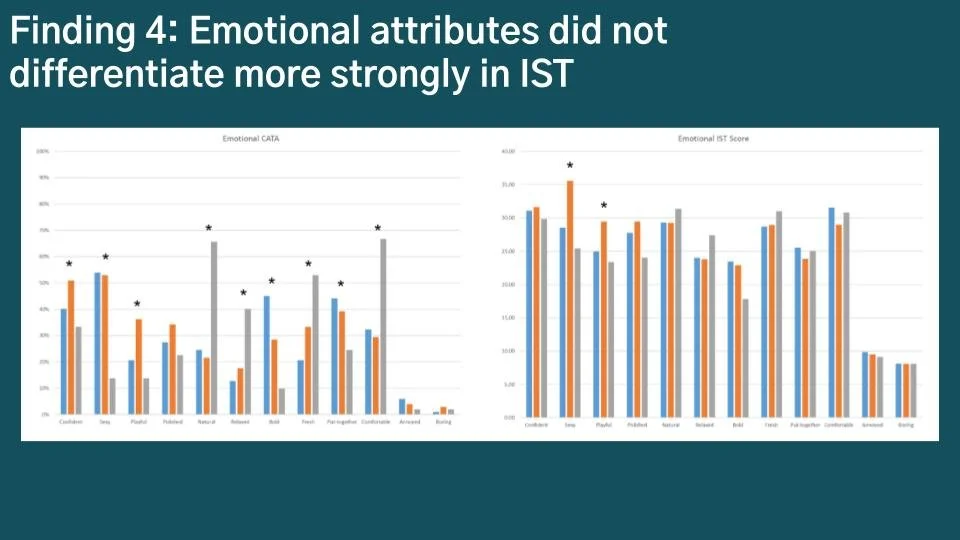
But emotional attributes did not show greater product differentiation in IST overall.
In fact, only a small number of emotional attributes significantly differentiated the product formats in the IST condition.
That doesn't mean implicit measurement "doesn't measure emotion."
That's the wrong conclusion because implicit is not an emotion method in the first place.
Emotion is one domain of association that can be examined under constrained responding, alongside functional, descriptive, brand, social, identity, or other associations.
What our findings challenge is the stronger assumption that making a measure implicit or reaction-time constrained will inherently uncover a deeper or more discriminating layer of emotional response.
Fast doesn't automatically mean emotional.
And fast certainly doesn't automatically mean true.
from SSP2026 presentation
But perhaps the method isn't the whole story
When we returned to these data for our SSP presentation, we started exploring another possibility.
What if some of the divergence between methods depends on who is doing the responding?
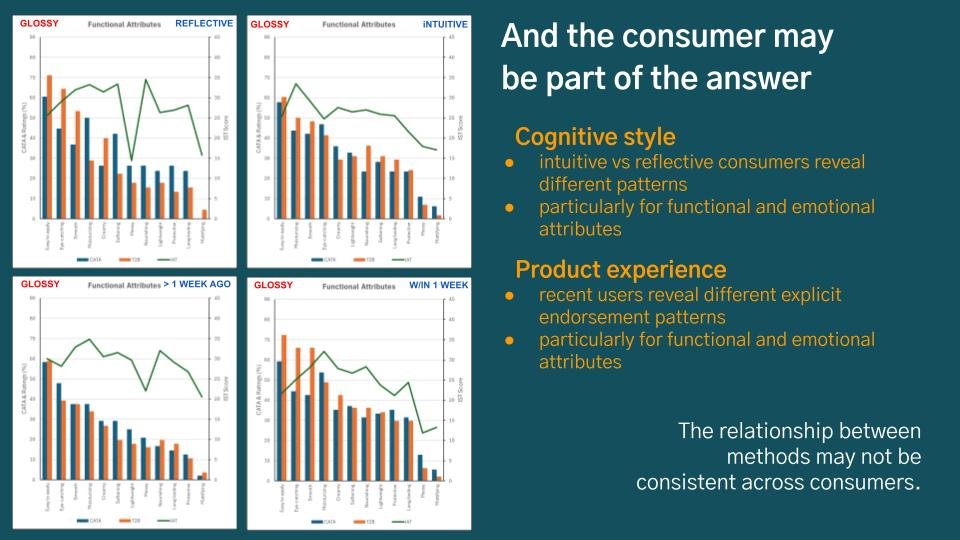
As part of the original research, we had collected a brief validated measure of cognitive reflection. This allowed us to explore differences between consumers who tended toward more intuitive versus more reflective styles of responding.
We also knew how recently participants had used the relevant product format.
These analyses are preliminary and should be treated as exploratory rather than definitive findings. But the patterns are intriguing.
When we separated more intuitive and more reflective consumers, the relationship between explicit and IST profiles was not identical. Differences appeared particularly within functional and emotional attributes.
We saw another pattern when looking at recent product experience.
Consumers who had used a product format more recently tended to show stronger explicit endorsement of several functional and emotional associations than consumers whose experience was less recent. The IST profile, however, did not simply shift in parallel.
That raises an intriguing possibility:
What we call a "method effect" may partly be a consumer × method interaction.
A recently experienced product may provide richer or more accessible information for reflective evaluation.
A consumer's tendency toward intuitive versus reflective processing may influence how much their explicit and time-constrained responses converge.
Familiarity, involvement, expertise, context, goals, or category knowledge could potentially matter as well.
We don't yet know.
But that uncertainty opens a much more interesting research space than simply asking which methodology wins.
from SSP2026 presentation
Maybe we're asking the wrong question
Our original question was straightforward:
Do implicit and explicit methods tell the same story?
The answer appears to be no, not always.
But I'm no longer convinced that's the question sensory and consumer researchers most need answered.
A better question may be:
Under what conditions, and for which consumers, do implicit and explicit responses converge or diverge?
That changes how I think about adding an implicit measure to a consumer study.
I wouldn't add one simply because I wanted to go "deeper."
I wouldn't assume that it will uncover emotions consumers can't articulate.
And I wouldn't interpret disagreement with self-report as evidence that the implicit result must be closer to the consumer's true response.
Instead, I would start with the research question:
What do I expect to learn by constraining the consumer's opportunity to deliberate?
If a product association remains strong across very different response conditions, that may itself be useful evidence.
If the association changes, that may also be useful, but now we have a question to investigate rather than an answer to declare.
And if we're ultimately interested in consumer decision-making, there's another piece of the model that we still need.
The missing piece: behavior
One of the theoretical reasons for interest in implicit measurement is the possibility that processes not fully captured by traditional self-report contribute to real-world choice and behavior.
That's an important hypothesis.
But it needs to be tested as one.
Our current study compared measurement approaches; it did not establish which one better predicts what consumers ultimately choose, purchase, use, repeat, or abandon.
That's the validation step I think becomes especially important.
Imagine measuring the same product associations explicitly and under constrained response conditions—and then observing actual choice.
Do explicit responses predict behavior better?
Does IST?
Does their combination provide more information than either alone?
Does the answer depend on whether the decision is habitual or deliberative? On category familiarity? On cognitive style? On how recently the consumer experienced the product?
Those are much more interesting questions than asking whether consumers "say one thing but really feel another."
Different methods. Different minds. Different questions.
I don't think these findings argue against implicit methods.
If anything, they argue for using them more thoughtfully.
Traditional sensory and consumer measures give us rich information about what consumers perceive, endorse, and differentiate when they have an opportunity to evaluate a product.
Reaction-time constrained approaches give us another view: what the associative landscape looks like when that opportunity for deliberation is reduced.
Sometimes those views converge.
Sometimes they don't.
And our preliminary analyses suggest that the relationship between them may itself depend on the consumer, their cognitive style, and their experience with the product.
The goal shouldn't be to decide which view reveals the "real consumer."
The opportunity is to understand why the views differ, when those differences matter, and whether they help us better explain what consumers ultimately do.
That's a much harder question.
But it's also a much more useful one.
Need an Implicit Research Doula?
Choosing the right research method isn't about finding the newest, fastest, or most sophisticated tool. It's about understanding what you need to know, what each method can actually tell you, and how the answer will inform a decision.
That's where I come in as a research doula, helping teams shape the question, choose and combine methods thoughtfully, evaluate new technologies, and make sense of results when different approaches don't tell the same story.
If you're considering implicit methods, behavioral science, biometrics, or another new addition to your research toolbox, and want an independent perspective on whether, when, and how to use it, let's talk.
