

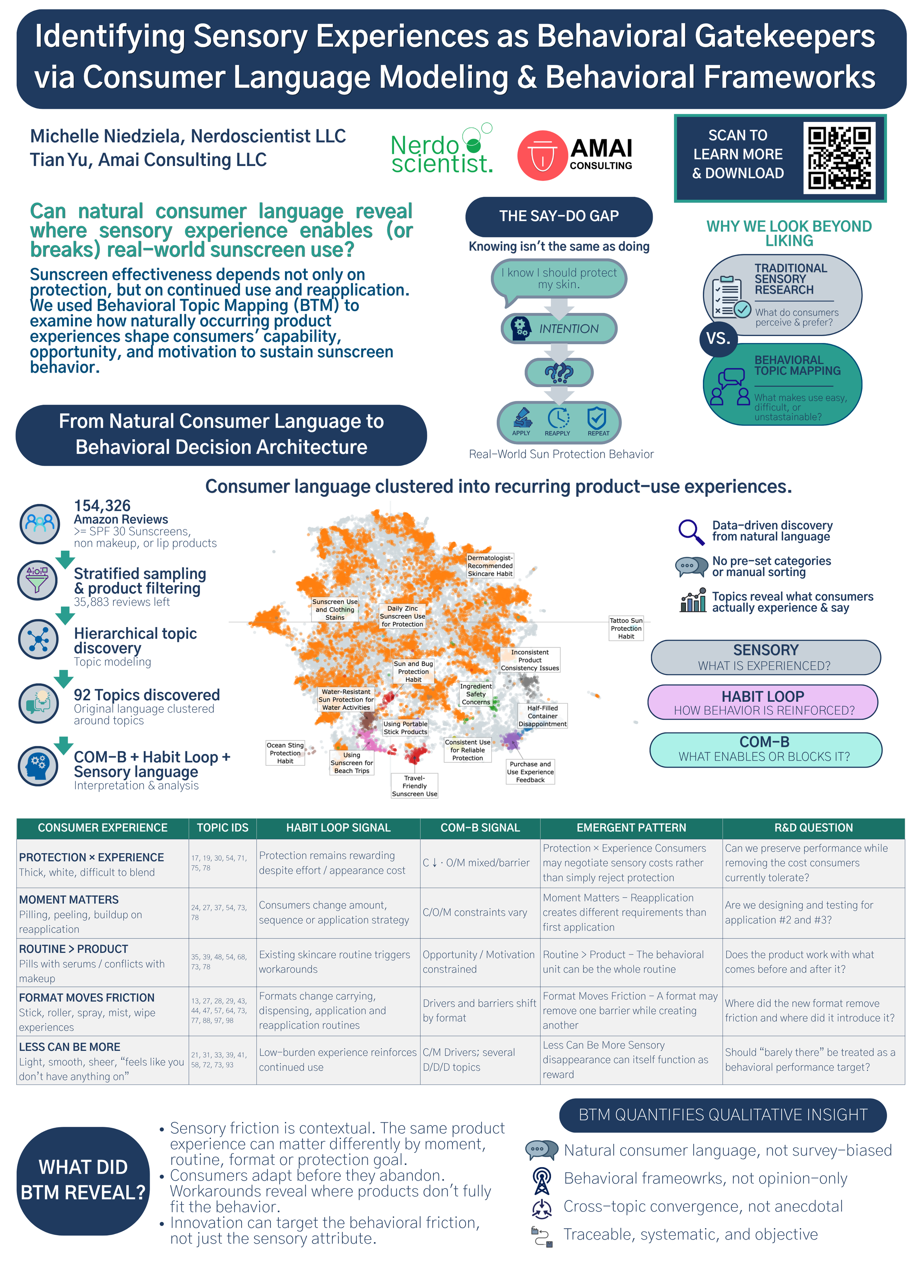
Eurosense 2026 poster presented in Oslo, Norway.
If you stopped by our poster at EuroSense, the first thing I’d probably tell you is that this isn't really a sunscreen study.
Sunscreen is the case study, but the question we were really interested in was much more broad:
Can the sensory experiences consumers describe in their own words tell us something about whether a product fits (or fails to fit) the behavior it was designed to support?
That question comes from a familiar problem we see as consultants in sensory and consumer science. As scientists, we are pretty good at measuring what people perceive. We're also pretty good at asking what they like and prefer. But liking a product and successfully incorporating it into everyday life aren't necessarily the same thing. And that shows in the failure of most of our measures at predicting purchase and repurchase behavior.
Sunscreen makes that distinction particularly visible.
Most people don't need to be convinced that sun protection is a good idea, they already know that. The behavioral challenge for R&D is getting them from:
“I know I should protect my skin”
to
apply → reapply → repeat.
And there are a lot of opportunities for the product experience to intervene across the experience journey between those points.
And that is what the say–do gap at the top of our poster is all about. Consumer can tell us they like it, but that doesn’t mean they are going to incorporate it into their lives and habits.
So what happens if we look beyond liking?
Rather than asking consumers another set of questions about sunscreen, we started with language consumers were already using to describe their experiences, in this case it was product reviews. Here people voluntarily offer vivid descriptions of their product experiences, including what happened, what they liked, what they didn’t like, how they accommodated, and if they’d buy it again as well as why. It’s a great resource (with some caveats of course).
Our original dataset contained 154,326 Amazon sunscreen reviews. We filtered the products and used stratified sampling to prevent a handful of extremely popular products from dominating the analysis, leaving 35,883 reviews for modeling.
We then used hierarchical topic modeling to discover recurring product-use experiences in the language.
This distinction is important.
We didn't begin by deciding that we wanted to study “texture,” “white cast,” “reapplication,” “packaging,” or any other predetermined set of sunscreen issues and then search the reviews for them. Text mining or social listening can often do just that. It looks for specific words and counts them up. That is not what we wanted to do. We wanted to understand exactly what the consumer meant with the words they used.
The topics emerged from their language, not ours.
And that produced 92 behaviorally interpreted topics, ranging from fairly familiar sensory experiences to things like travel, water resistance, scalp protection, sunscreen sticks, clothing stains, product consistency, packaging failures, dermatologist recommendations, reapplication, layering with skincare, and ingredient concerns.
“But isn't that just topic modeling?”
This is probably one of the first questions I'd expect from someone familiar with text analytics.
And the answer is: topic modeling is the discovery step, not the endpoint.
Knowing that consumers frequently talk about white cast or a spray nozzle tells us what they're experiencing. It doesn't necessarily tell us how that experience becomes behaviorally consequential.
That's where we added three different analytical lenses (using 3 frameworks in this case).
Sensory language asks:
What is being experienced?
Habit Loop asks:
How does that experience reinforce or disrupt the behavior?
And COM-B asks:
Does the experience affect consumers' Capability, Opportunity or Motivation to perform the behavior?
So instead of stopping at:
“Consumers complain about pilling.”
we can start asking:
Where does pilling enter the consumer's routine, what does the consumer do in response, and how might that affect future sunscreen use?
That shift, from identifying an experience to understanding its place in the behavior, is what we mean by Behavioral Topic Mapping (BTM).
How did we keep ourselves from cherry-picking interesting topics?
This became an important methodological issue as we worked through the analysis.
With 92 topics, it would have been very easy to find five particularly interesting examples and build a compelling story around them.
So we deliberately did the opposite.
One very broad category-level topic was excluded from comparative synthesis, leaving 91 specific topics. We then reviewed the complete topic universe before selecting examples for the poster.
We looked for recurring patterns across independent topics, and then asked whether those topics also showed convergence across the sensory language, Habit Loop interpretation and COM-B interpretation.
We also retained positive, negative and mixed examples.
And importantly, topic size was not used as the primary criterion for deciding that something was important.
That process led to the five patterns in the table at the bottom of the poster.
What did consumers' experiences reveal?
1. Protection × Experience: consumers can negotiate sensory costs
One of the most interesting things in the data was that an unpleasant product experience didn't necessarily mean consumers rejected sunscreen.
Across topics involving thickness, white cast, difficult blending, peeling, paste-like texture and pilling, the protection benefit could remain rewarding even when the experience of achieving it was costly.
That matters.
A traditional interpretation might be:
Consumers dislike thick sunscreen → make sunscreen less thick.
Our behavioral interpretation is slightly different:
Consumers may be tolerating an experiential cost because the protection reward is valuable enough.
That gives R&D a different question:
Can we preserve the performance consumers value while removing the cost they're currently tolerating?
In other words, don't assume that continued use means the experience has been successfully designed.
Sometimes consumers are simply putting up with it.
2. Moment Matters: reapplication isn't just application again
This may be one of the most actionable findings.
We tend to talk about “sunscreen application” as though it were one behavior.
The consumer language suggests otherwise.
Initial application happens on relatively clean skin. But the second or third application may happen over sweat, skincare, makeup, an earlier layer of sunscreen, or a combination of all four.
And that's where we saw topics involving pilling, peeling, buildup, changing amounts, changing application strategy and difficulty integrating reapplication into the day.
Importantly, we also found positive counterexamples. Fine-mist formats, for example, could make daytime reapplication easier in particular contexts.
So the innovation question becomes:
Are we designing and testing sunscreen for application #2 and #3—or mostly for application #1?
For sensory researchers, I think that's a particularly interesting question.
A product could perform beautifully in a controlled first-application test and still fail at the point in the behavioral journey where continued protection actually depends on it.
3. Routine > Product: sometimes the product isn't the right unit of analysis
Several topics pushed us beyond sunscreen altogether.
Consumers talked about sunscreen in relation to serums, moisturizers, foundation, makeup, skin treatments and the sequence in which products were applied.
When something went wrong, consumers sometimes changed the amount they used, changed the sequence, changed the time of day, or switched products.
Those workarounds are useful behavioral evidence.
They suggest that the consumer isn't really performing a “sunscreen behavior.”
They're performing a skincare routine in which sunscreen has to find a place.
So our R&D question becomes:
Does the product work with what comes before and after it?
This has methodological implications too.
If we test the sunscreen in isolation, we may be optimizing the wrong behavioral unit.
4. Format Moves Friction
The reviews gave us a particularly nice view of different delivery formats: sticks, rollers, sprays, mists, wipes, pumps and other applicators.
And format innovation clearly can make behaviors easier.
A stick can be portable and less messy. A format that a child can apply independently changes who can perform the behavior. A fine mist can make reapplication easier.
But formats also created new problems.
Hardness. Melting. Transfer. Poor dispensing. Sticky wipes. Clogged nozzles. Pumps that stop working. Buttons that are difficult to press.
That led us to a principle we hadn't started the analysis looking for:
A new format doesn't necessarily eliminate behavioral friction. It may relocate it.
So rather than asking only:
Is this format easier to use?
we might ask:
Where in the behavioral sequence did this format remove friction and where did it introduce new friction?
Carry → open → dispense → apply → cover → wear → reapply.
That's a much richer way of evaluating format innovation.
5. Less Can Be More
Finally, we wanted to make sure we weren't telling a story composed entirely of barriers and failures.
Some of the clearest positive patterns involved language such as light, smooth, sheer, easy, quick-absorbing, and even:
“Feels like you don't have anything on.”
Those experiences tended to align with lower-burden application and positive behavioral reinforcement.
And that raises an interesting sensory question.
In many product categories, sensory innovation is about creating more experience: richer flavor, stronger aroma, more indulgent texture.
But sunscreen is an instrumental product. The consumer primarily wants the protection.
So perhaps the optimal sensory reward sometimes isn't a highly pleasurable sunscreen experience.
Perhaps it's sensory disappearance.
The product does its job while asking very little of the consumer's attention.
That leads to another potential design target:
Should “barely there” be treated as a behavioral performance metric rather than simply a liking attribute?
“So are you saying sensory properties cause sunscreen adherence?”
No.
And that's an important limitation.
These are naturally occurring consumer reviews, not a controlled behavioral experiment. We cannot conclude that changing a sensory property will causally increase adherence or reapplication.
Nor should topic frequency be interpreted as population prevalence.
What the analysis does give us is something different: naturally occurring evidence about where product experiences repeatedly intersect with behavior.
That makes BTM particularly useful as a hypothesis-generation and innovation-discovery tool.
It tells us where we might want to run the next experiment.
For example:
Does reducing pilling actually increase appropriate reapplication?
Does a lower-effort dispensing mechanism increase dose or coverage?
Does testing sunscreen within a complete skincare routine better predict continued use than isolated product testing?
Those are experimentally testable questions that emerge from the consumer language.
“Why use COM-B and Habit Loop together?”
Because they answer different questions.
COM-B helps diagnose what is enabling or constraining the behavior.
A difficult dispenser might create a Capability problem. Lack of availability might create an Opportunity problem. An unpleasant consequence might undermine Motivation.
Habit Loop adds the temporal piece.
It asks what cued the behavior, what routine followed, and what reward or consequence came next and therefore what might reinforce, modify or disrupt the next occurrence.
Put together, they help us move from:
What did the consumer experience?
to:
What did that experience do within the behavioral system?
Neither framework is intended here as a diagnostic truth about an individual consumer. They're structured interpretive lenses applied across recurring language patterns.
And importantly, these aren’t set in stone. Given a different product or different type of consumer, maybe Habit Loop and COM-B aren’t the frameworks we should use. Maybe it’s Jobs-to-be-Done? Maybe it’s Goal Systems? Loss aversion? Social norms? And so on and on and on. The list could be infinite. But that’s the beauty of the BTM approach. It’s not a turnkey metric. It’s a thoughtful and systematic way to approach what consumers are really saying and doing. Trying to avoid as much bias as possible.
What I think BTM adds to sensory and consumer science
The bottom of the poster summarizes our broader takeaway.
First, sensory friction is contextual.
The same sensory property can matter differently depending on whether someone is applying for the first time, reapplying over makeup, protecting a child's face, covering a bald scalp, going swimming, or trying to fit sunscreen into an established skincare routine.
Second, consumers adapt before they abandon.
Workarounds, like changing sequence, changing amount, changing format, changing timing, are particularly valuable signals because they show us where consumers themselves are trying to redesign the experience.
And third:
Innovation can target the behavioral friction, not just the sensory attribute.
That may be the most important distinction.
“Reduce pilling” is a formulation problem.
“Make sunscreen compatible with repeated application over an existing skincare and makeup routine” is an innovation problem grounded in behavior.
The sensory attribute hasn't disappeared. We've simply placed it in a larger behavioral architecture.
The bigger question
For us, sunscreen is a useful demonstration because the gap between intention and sustained behavior is easy to see.
But the approach isn't inherently about sunscreen.
Many sensory and consumer products depend on repeated behavior: personal care routines, oral care, functional foods, supplements, household products, health-related products, and even foods and beverages where preparation, context or repeated consumption matter.
In all of those cases, we can ask something beyond:
What do consumers perceive and prefer?
We can ask:
Where does the product experience make the desired behavior easier—and where does it quietly make that behavior harder to sustain?
That's the question Behavioral Topic Mapping is designed to help us explore.
And if you're at EuroSense and have thoughts about where this approach could (or couldn't) work, please come argue with us at the poster. If you didn’t make it to the meeting, drop us a not here, set a meeting, and let’s talk. Those are exactly the conversations we're hoping to have.
