

AI Can Talk About Smell. But Can It Smell?
What happens when we connect chemical sensing, human language, and AI, and why sensory scientists need to be part of the conversation.
Artificial intelligence can tell you a lot about smell.
Ask an LLM what vanilla smells like and it will happily describe it as sweet, creamy, warm, or comforting. Ask it what you might smell in a spa, a bakery, or after a summer rainstorm, and you'll probably get a pretty convincing answer.
But there’s an important catch:
The AI hasn't smelled any of those things.
Most of what today's general-purpose AI "knows" about smell comes from language: things humans have written about odors, products, ingredients, places, and experiences.
That distinction has been on my mind for a while. And it became particularly interesting through conversations with my collaborators Tian Yu (Amai Consulting) and Kordel France. (Sentience Robotics)
At the 2026 Society of Sensory Professionals conference, we're presenting some early thinking about what it might look like to begin closing that gap.
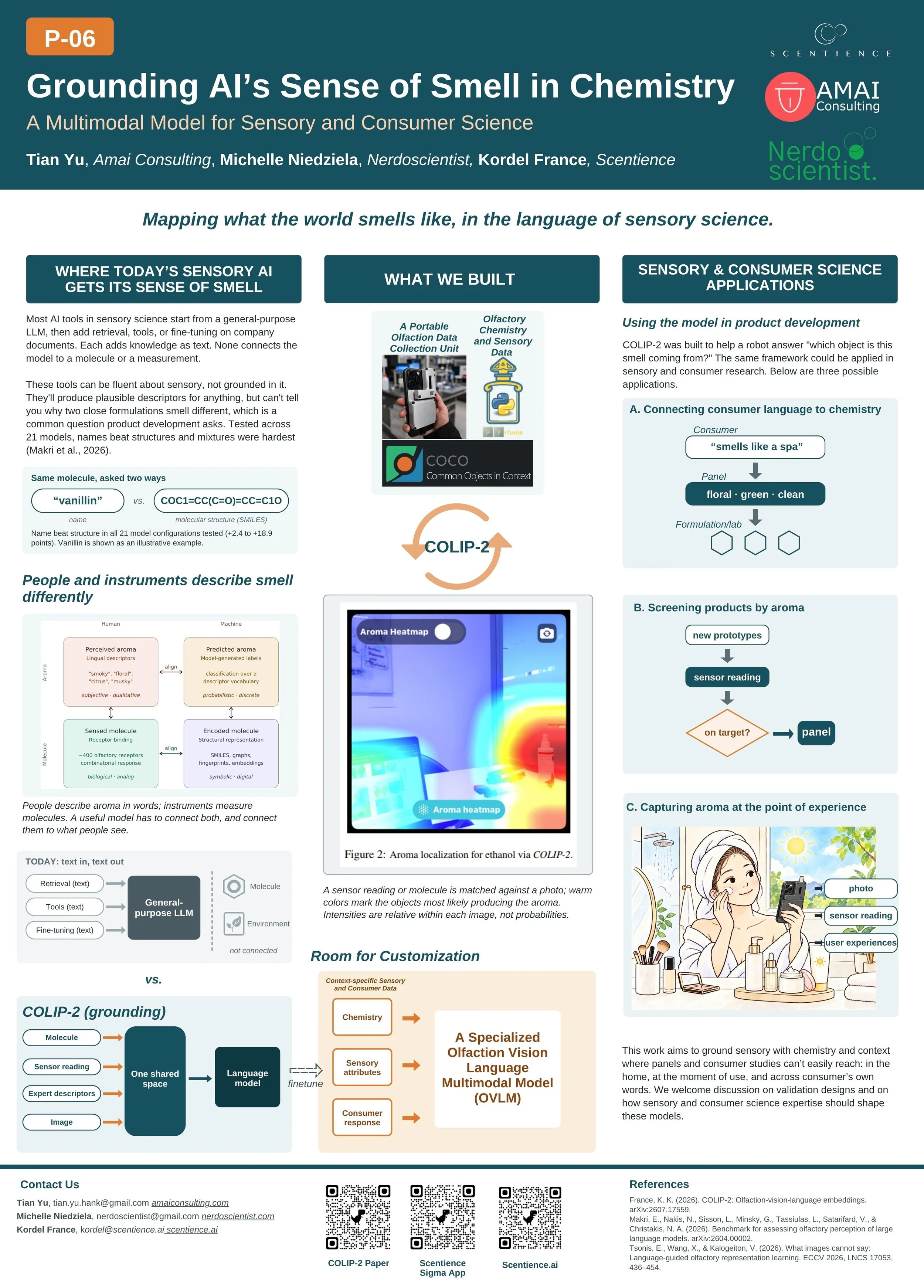
Our SSP2026 Poster
People and instruments speak different languages
Here's the fundamental problem.
A person smells something and says:
"It smells floral."
Or perhaps:
"It smells like a spa."
An analytical instrument doesn't say that.
It measures molecules, concentrations, or sensor responses.
And an LLM? It mostly works with the enormous body of language humans have created about those things.
These are three different representations of the same world.
That becomes particularly important when we start talking about using AI in sensory and consumer science. Many current approaches begin with a general-purpose LLM and then improve it through retrieval, tools, fine-tuning, or proprietary company knowledge. Those approaches can make the model more knowledgeable about sensory science, but the information still largely enters as text.
The model isn't necessarily connected to the thing being sensed.
Recent benchmarking illustrates the distinction nicely. Models perform better when given the familiar name of an odor molecule than when given its molecular structure, and mixtures remain particularly difficult. In other words, an AI may know what humans have said about a molecule better than it understands the chemical information itself.
So Kordel has been working on a different question:
Can we ground the model in the physical world?
From words about smell to chemical sensing
Kordel developed COLIP-2 initially around a robotics problem.
Imagine a robot detects an odor in its environment.
It's not enough for the robot to know what chemical signal it has detected. To act on that information, it may also need to determine:
Where is it coming from?
COLIP-2 approaches this by placing different kinds of information (including molecular information, sensor readings, expert odor descriptors, and images)into a shared representational space.
That creates some interesting possibilities.
For example, if a sensor detects ethanol while looking at a scene, the model can associate that sensor information with objects in the image that are most likely related to that aroma. The resulting heatmap represents relative associations within that particular image, not probabilities that a specific object is definitively producing the odor.
That's interesting for robotics.
But Tian and I started wondering:
What could this mean for sensory and consumer science?
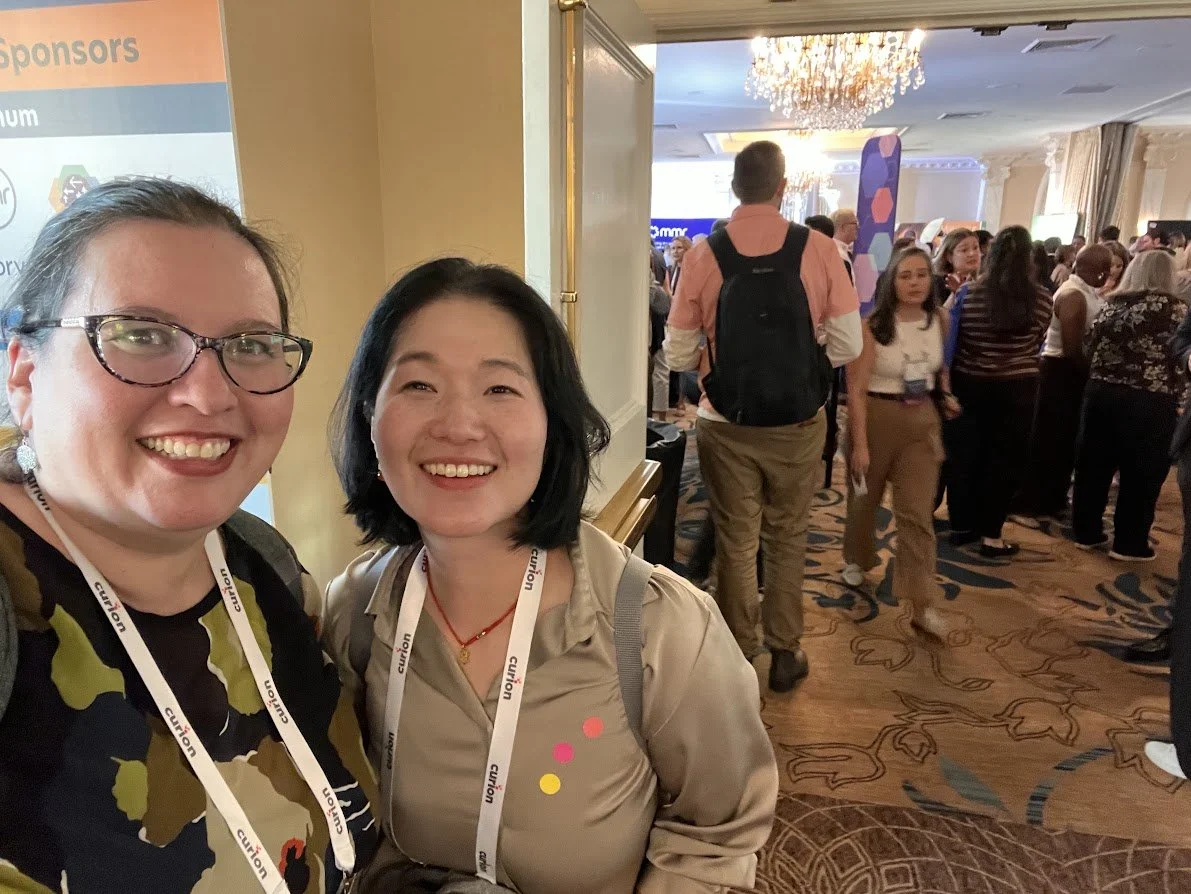
Tian and I during the SSP2026 Poster Session
Connecting chemistry to human experience
This is where the project became particularly interesting to me.
Tian and I have been working from almost the opposite direction: using the natural language people produce about products and experiences to better understand perception and behavior.
Consumers don't necessarily say:
"I perceive elevated floral intensity with moderate green notes."
They say:
"It smells like a spa."
Those statements contain different kinds of information.
The trained sensory panel gives us a carefully controlled perceptual vocabulary. The consumer gives us meaning, associations, context, and lived experience. The instrument gives us chemistry.
What if we could better connect all three?
Or as I liked to describe it when we presented the start of this journey at AChemS earlier this year: It’s like if C3PO from Star Wars could smell…
That's the idea we're beginning to explore.
Importantly, we're not claiming that detecting a collection of molecules tells us exactly what a human standing in that environment will smell.
Human olfactory perception isn't simply a chemical readout. Concentration matters. Mixtures matter. Context matters. Individual differences matter. And the relationship between a sensor response and human perception needs validation.
In fact, that's precisely why I think this becomes a sensory-science problem rather than simply an AI or engineering problem.
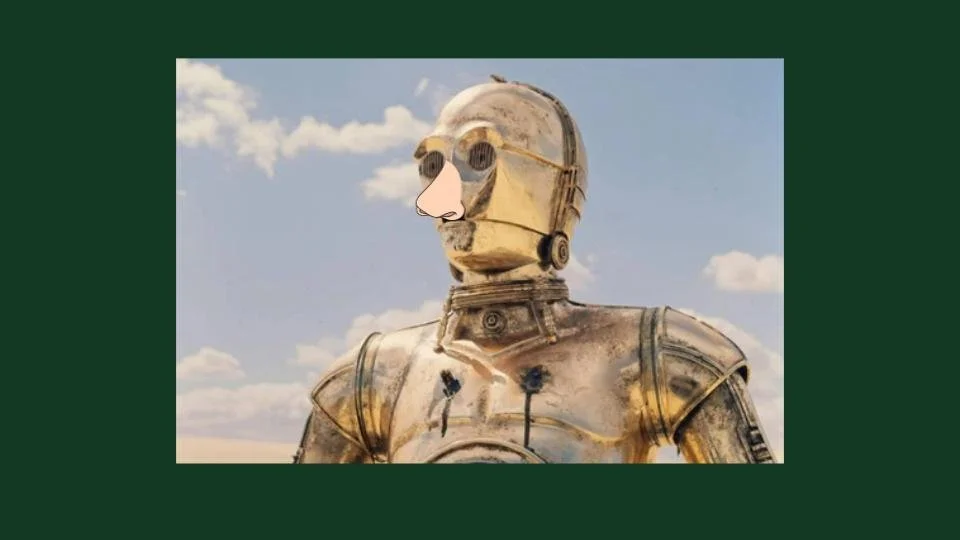
Slide from our AChemS2026 presentation
What might we actually do with it?
For our SSP poster, we've imagined three possible directions.
One is connecting consumer language to chemistry.
A consumer says:
"It smells like a spa."
Could we begin connecting that natural description to sensory attributes such as floral, green, or clean, and ultimately to formulation or chemical information?
Another possibility is product screening.
Could sensor measurements provide a rapid first screen of prototypes, with trained sensory panels providing the perceptual validation?
And perhaps the possibility I find most intriguing is capturing aroma at the point of experience.
Imagine an in-home product study in which, at the same moment, we could capture:
what is happening chemically in the environment,
something about the physical and visual context,
what the consumer says they are experiencing,
and eventually what they do next.
Now we're no longer simply asking someone later, "What did the product smell like?"
We're beginning to connect the physical environment to perception, language, context, and behavior as the experience unfolds.
The model isn't the answer
This is also where I think we need to be careful.
It's tempting with AI to jump quickly from:
"The model found an association"
to:
"The model understands the experience."
Those are not the same thing. A model-generated "aroma fingerprint," for example, might provide a useful hypothesis about the perceptual descriptors associated with a set of detected chemical signals.
But the next question should be:
Does that fingerprint correspond to what people actually smell?
That's where sensory science comes in. What should count as ground truth? A trained descriptive panel? Consumer perception? Both?
How should we account for concentration and mixture effects?
When is expert sensory vocabulary useful, and when does natural consumer language tell us something different?
How do we validate these models before making product-development decisions with them?
Those aren't problems AI can simply engineer away.
They're sensory-science questions.
Ground first. Then customize.
One aspect of the framework that I particularly like is the distinction between grounding and customization.
First, we need models that connect to the physical world: to molecules, sensor signals, sensory descriptors, and environmental context.
Then we can ask what happens when that foundation is customized using a company's own chemistry, sensory attributes, products, and consumer data.
The poster describes this as:
“Mapping what the world smells like, in the language of sensory science.”
I think that's a useful way to think about where this could go.
Not an AI that replaces the sensory scientist. Not a sensor that magically tells us what consumers experience.
But potentially a new translation layer connecting things we've historically measured separately:
Chemistry ↔ sensing ↔ perception ↔ language ↔ context ↔ behavior
And sensory and consumer scientists should be deeply involved in determining what those connections actually mean.
That's why we brought this to SSP
This poster wasn’t really trying to say:
"Look, we solved AI olfaction."
Quite the opposite.
It's an invitation.
The technical pieces are developing quickly. But if we're going to create systems that meaningfully connect chemical sensing with human experience, then we need expertise in psychophysics, sensory measurement, consumer language, context, experimental design, and validation.
In other words, we need sensory scientists.
So if you missed us at SSP reach out and let’s chat about it.
We'd particularly like to hear where you think this could be useful, where you think it could go wrong, and… perhaps most important…
What would you need to see before you trusted it?
Because that may be the most interesting research question of all.
