

SSIB 2026: Beyond Liking: What Potato Chip Reviews Can Teach Us About Ingestive Behavior (conference poster)
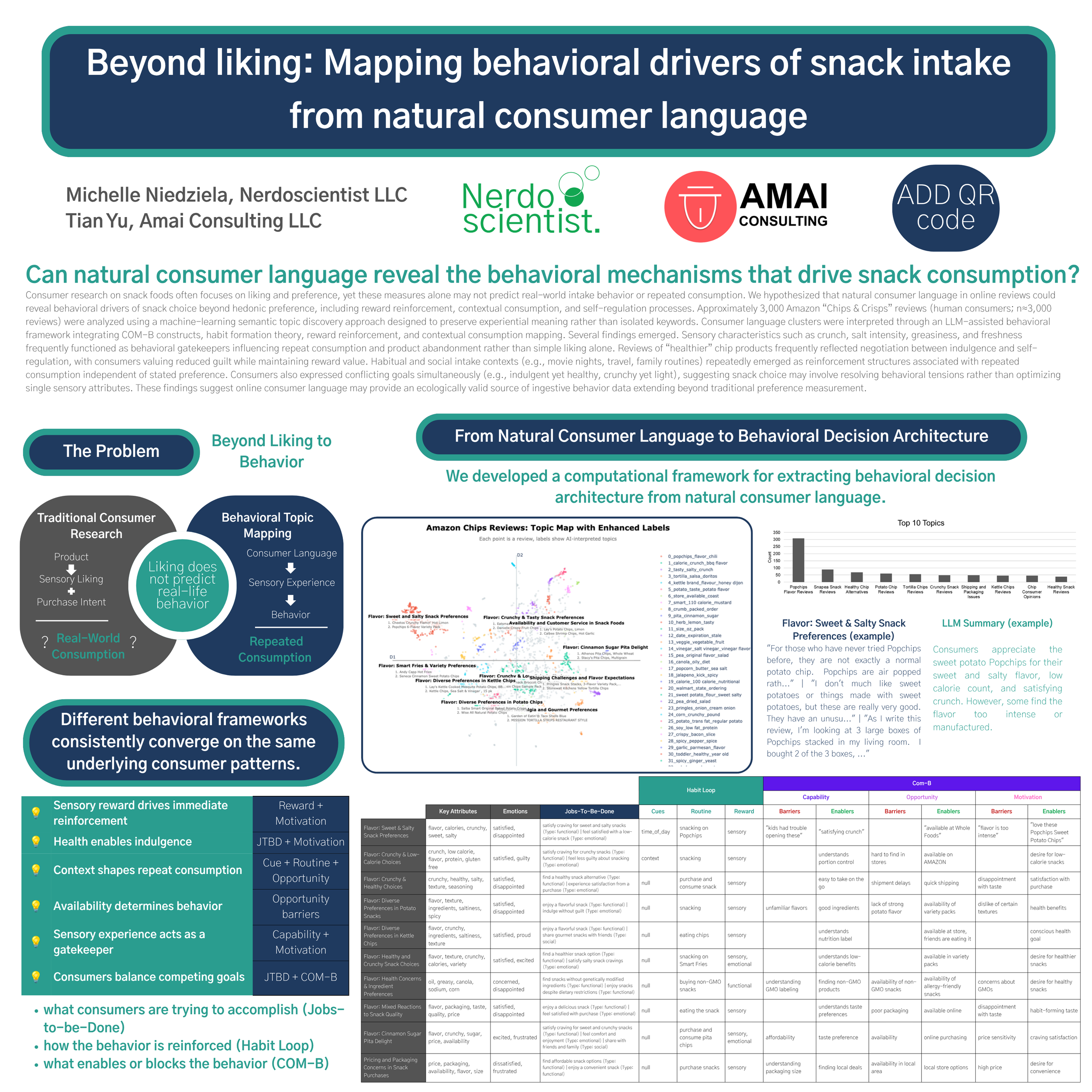
Our poster for Society for Ingestive Behavior meeting in Philadelphia 2026
Originally presented at the Society for the Study of Ingestive Behavior (SSIB) Annual Meeting
When we study food choice, we often measure things like liking, preference, purchase intent, or willingness to buy. These are valuable measures, but anyone who has ever bought a bag of chips they didn't particularly love (or kept buying one they knew they probably shouldn't) knows that preference isn't the whole story.
Behavior is.
The question that motivated this work was simple:
Can we learn something about real-world ingestive behavior by listening to how consumers naturally describe their experiences?
Rather than asking people to complete another survey, we analyzed approximately 3,000 Amazon reviews for potato chips and crisps. These reviews capture something that laboratory studies often struggle to observe: how people describe eating, purchasing, repurchasing, recommending, and abandoning products in everyday life.
This poster represents one of the first applications of what we're calling Behavioral Topic Mapping.
The Challenge
Traditional topic modeling is very good at answering questions like:
What themes appear in consumer reviews?
Which flavors are mentioned most often?
What complaints are common?
Those are useful questions.
But they aren't necessarily behavioral questions.
Behavioral scientists tend to ask different ones.
Why does someone keep buying a product?
What causes them to stop?
What role does context play?
When does a sensory experience reinforce a behavior and when does it interrupt it?
Our goal was to move from topics to behavioral mechanisms.
The Behavioral Topic Mapping Pipeline
The process happens in several stages.
Step 1 — Listen
We begin with thousands of natural consumer comments.
No surveys.
No synthetic respondents.
Just people describing their own experiences in their own words.
Step 2 — Discover Topics
Machine learning groups semantically similar reviews into recurring themes while preserving meaning rather than relying solely on keyword counts.
Instead of producing a long list of words, the algorithm identifies coherent consumer experiences.
Step 3 — Interpret Behavior
This is where Behavioral Topic Mapping differs from traditional topic modeling.
Rather than stopping at:
"Consumers talk about crunch."
we ask:
What role does crunch play in behavior?
To answer that question, each topic is interpreted using several complementary behavioral frameworks (and very much dependent on the context).
Jobs-to-Be-Done
Habit Loop
COM-B
emotional interpretation
contextual interpretation
Each framework highlights a different aspect of decision making.
What We Found
Several patterns appeared repeatedly across very different chip products.
1. Sensory experiences are behavioral gatekeepers.
Consumers rarely described crunch, freshness, or greasiness simply as attributes they liked or disliked.
Instead, these experiences often determined whether a product became part of their routine or disappeared from it.
A satisfying crunch reinforced repeat consumption.
A greasy texture often became a reason not to purchase again.
The sensory experience wasn't just creating liking.
It was influencing future behavior.
2. Health often functions as permission.
Many "healthy" chip products weren't celebrated because consumers wanted nutrition.
Instead, consumers frequently described these products as allowing them to enjoy a snack with less guilt.
This suggests that health claims often function as behavioral permission structures.
Consumers are balancing indulgence and self-regulation rather than replacing one with the other.
3. Context matters.
Many reviews naturally referenced situations rather than products.
Movie nights.
Road trips.
Lunches.
Family sharing.
These contexts became cues that reinforced habitual consumption.
The chip wasn't simply chosen because it tasted good.
It fit a behavioral routine.
4. Consumers manage competing goals.
One of the most interesting findings was how often consumers expressed contradictory desires.
They wanted products that were:
indulgent yet healthy
crunchy yet light
satisfying yet portion controlled
flavorful yet not overwhelming
These aren't inconsistencies.
They're behavioral tensions.
And they may represent some of the most promising spaces for innovation.
Looking Across Behavioral Frameworks
One question we asked was whether different behavioral frameworks would tell different stories. But what we found instead was that they often converged.
Jobs-to-Be-Done highlighted what consumers were trying to accomplish.
Habit Loop revealed how behaviors became reinforced.
COM-B identified what enabled, or prevented, those behaviors.
Despite approaching the data from different perspectives, all three frameworks repeatedly pointed toward the same behavioral themes.
That convergence gives us greater confidence that these aren't simply artifacts of one theoretical model.
Why This Matters
This project isn't really about potato chips.
It's about developing better tools for understanding behavior.
Natural consumer language contains much richer behavioral information than is often recognized.
When combined with computational topic discovery and theory-guided behavioral interpretation, it becomes possible to move beyond describing what consumers say toward understanding how everyday experiences shape real-world decisions.
Our goal isn't to replace traditional sensory or consumer research.
It's to complement it.
Behavioral Topic Mapping helps reveal how sensory experience, context, emotion, habits, and goals work together to influence what people actually do and not just what they say they prefer.
Where We're Going Next
This potato chip project serves as a proof of concept.
We're now exploring how Behavioral Topic Mapping can be applied to categories including skincare, sun protection, health and wellness, GLP-1 experiences, and other consumer products where behavior—not simply preference—ultimately determines success.
As AI continues to improve, the role of Behavioral Topic Mapping is not to replace behavioral scientists, but to help them listen to consumer experiences at a scale that was previously impossible.
The interpretation remains grounded in behavioral science.
The technology simply helps us hear more of the conversation and we’d love to talk to you about it!
