

Everything Has a Formula
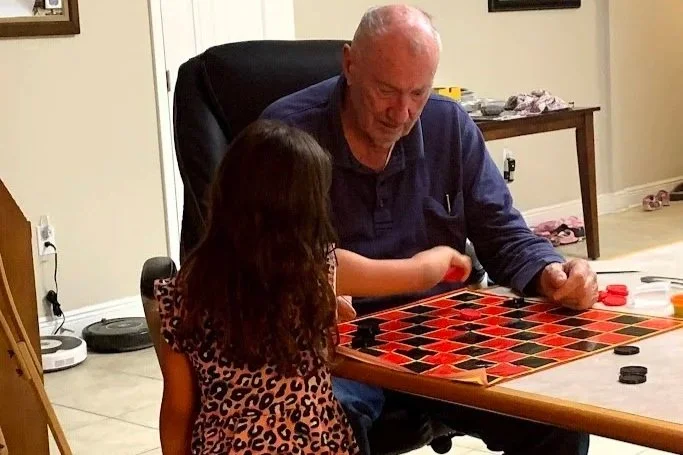
My dad teaching my daughter to play checkers.
When I was growing up, my dad used to say: "Everything has a formula."
Not a mathematical formula. A way of thinking.
If I wanted to learn to draw, he’d tell me there was a formula and try to walk me through it. If I wanted to play pool, there was a formula. If I wanted to cook, there was a formula.
He didn't mean that every artist painted the same way or that every great meal followed the same recipe. He meant that behind every skill was an underlying structure. If you could figure out how something worked, what mattered, what didn't, and how the pieces fit together, you could learn it.
More importantly, he believed that almost anyone could do anything. You just had to learn the trick to it.
That was a powerful lesson for a kid. It made difficult things feel less intimidating. Instead of asking, "Am I naturally good at this?" I learned to ask, "What's the formula?" or “How does this work?“
I didn't realize it then, but that question would shape the way I approach consumer research decades later.
More Than Just the Facts
More recently, while doing some estate planning with a lawyer, I came across the legal term fact pattern, and it immediately resonated with me. I even told the lawyer how much I liked it, since he in turn loves to chat about neuroscience with me.
In law, a fact pattern isn't just a list of facts. It's the collection of circumstances that together determine how a case should be understood. A single fact rarely tells you much on its own. The meaning comes from how the facts relate to one another.
Imagine someone enters a house and leaves carrying a television.
That single observation doesn't tell you whether they committed a crime.
Were they helping a friend move? Were they the homeowner? Did they have permission? Did they break a window to get inside? Those additional facts completely change the interpretation.
Lawyers don't simply collect facts. They interpret the pattern.
That idea struck me because it's exactly how I think about consumer behavior.
The Search for the Formula
People often ask me what the biggest consumer insight was from a project.
It's an understandable question.
But I've always been slightly uncomfortable with it because it suggests that somewhere in an interview there is a magical quote waiting to be discovered or a sentence that suddenly explains everything.
In reality, that's rarely how understanding works.
One consumer says a sunscreen feels greasy.
Another says they never remember to apply it before leaving the house.
Someone else only wears sunscreen on vacation.
Another buys mineral sunscreen because they believe it's healthier but quietly admits they never finish the bottle.
Viewed individually, these are simply observations.
Together, they begin to tell a story.
Not because any one person is "right," but because recurring patterns begin to emerge. The behaviors reinforce one another. The contradictions become meaningful. What first looked like disconnected comments starts to reveal an underlying structure.
That's the formula.
Not a rigid rule that predicts exactly what every consumer will do, but a behavioral mechanism that explains why seemingly unrelated observations keep appearing together.
Looking Beyond Trends
This is one reason I've become increasingly skeptical of how we talk about trends and consumer insights.
Trend reports are full of interesting facts:
Consumers want simpler ingredients.
Consumers care about sustainability.
Consumers are prioritizing wellness.
Consumers are looking for convenience.
All of these statements may be true.
But they often stop one step too early.
They describe what is happening without explaining why.
Without understanding the behavioral structure underneath, it's difficult to know whether a trend represents a lasting shift, a temporary reaction, or something that will evolve into an entirely different opportunity.
Knowing that consumers buy mineral sunscreen is useful.
Understanding that they are balancing health concerns, daily routines, cosmetic elegance, social expectations, and habit formation is much more useful.
The facts matter.
The pattern matters more.
Research as Pattern Recognition
This realization has shaped almost everything I do.
Whether I'm facilitating a behavioral workshop, mapping a consumer journey, or analyzing thousands of online conversations through Behavioral Topic Mapping, I'm rarely looking for the most memorable quote.
I'm looking for recurring behavioral structures.
What expectations consistently lead to disappointment?
What contextual barriers repeatedly interrupt good intentions?
Which emotions appear alongside certain routines?
What tradeoffs do people keep making, even when they don't explicitly recognize them?
Individual comments are clues.
Patterns are evidence.
Behavioral mechanisms are explanations.
Once you begin looking for those mechanisms, something interesting happens. You stop asking what consumers said and start asking what generated those experiences in the first place.
That's where innovation becomes much more interesting.
Because once you understand the mechanism, you aren't limited to solving today's problem. You can begin anticipating tomorrow's.
Back to My Dad
My dad passed away in 2022 and we miss his lessons immensely. I don't think he ever imagined that his advice would influence the way I conduct research.
He was just trying to convince me that difficult things weren't impossible. That behind every seemingly impossible skill was something that could be understood.
Something with structure.
Something with a formula.
Years later, I still approach nearly every research question the same way.
Not by asking, "What's the insight?"
Not even by asking, "What's the trend?"
But by asking the question that started it all:
"What's the formula?"
Because when you understand the formula, you stop collecting facts.
You start understanding behavior.
So what does this actually mean?
If your team is swimming in research data but still asking, "So what does this actually mean?", it may be time to stop looking for more facts and start looking for the pattern.
That's where I love to help. Whether through Behavioral Topic Mapping, workshops, or behaviorally informed research, my goal isn't simply to uncover what consumers are saying. It's to help teams understand the behavioral formula underneath, so they can build products, experiences, and strategies that address the causes of behavior, not just the symptoms.
Because the most valuable insight isn't usually another data point.
