

A Nerdoscientist’s Year-End Guide to Conferences That Actually Matter
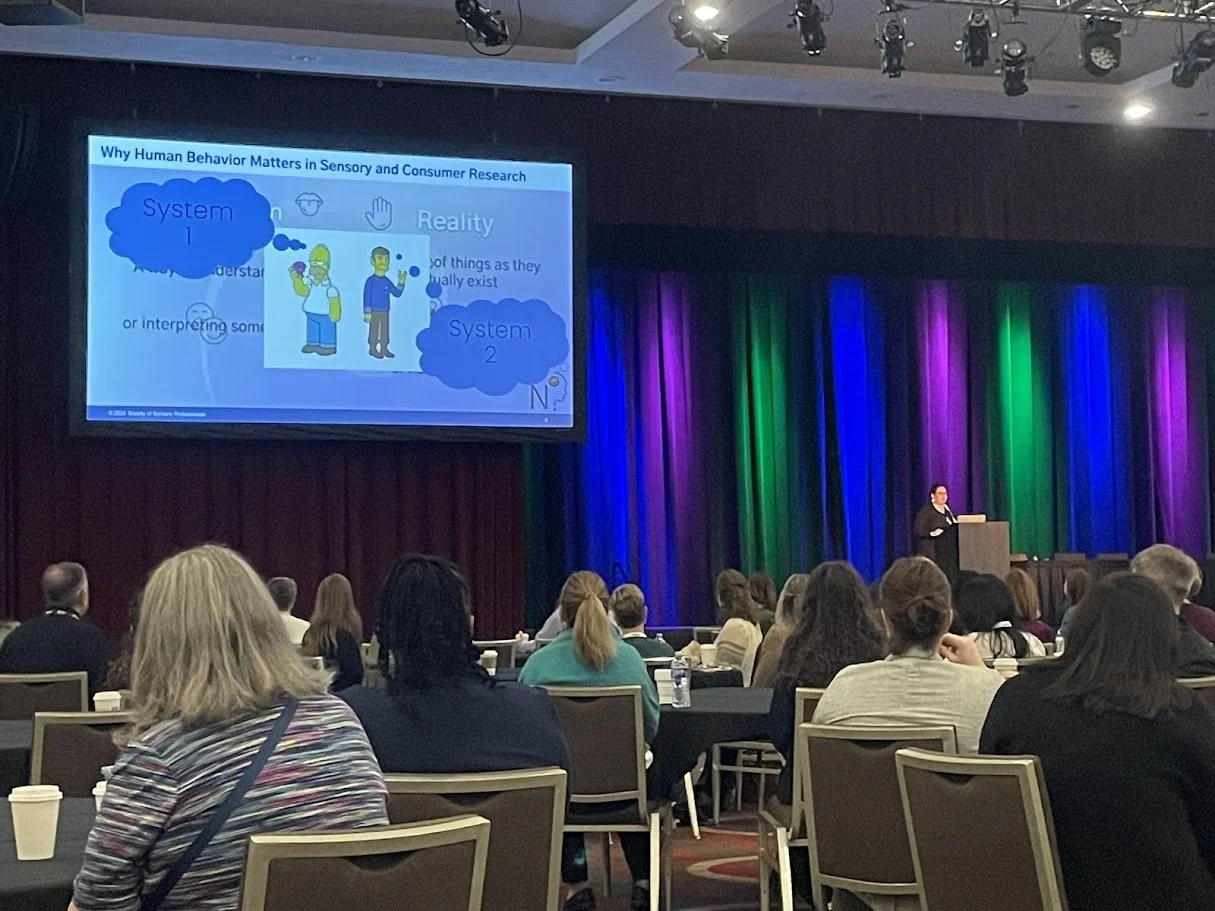
Hi! It’s me… talking about Behavioral Science at SSP!
As the year winds down, I’ve found myself having the same conversation over and over again with clients, collaborators, and friends across industry and academia:
“What conferences are we going to next year?”
“Where are the good conversations happening?”
“Is there a meeting that really sits at the intersection of behavioral science, consumer research, and sensory?”
Most recently, this came up in a conversation with Richard Popper, where we talked about something many of us have felt for a while but don’t often articulate clearly: there is a noticeable lack of conferences that are truly behavioral science–focused, while still being grounded in sensory and consumer research. Some clients have been asking me… what should meetings should I attend for the latest BeSci?
The interest is clearly there. You see it in packed sessions on emotion, decision-making, context effects, anticipation, and behavior, often standing-room-only talks embedded within broader sensory or consumer science meetings. And from a business perspective you can also see it, the demand is undeniable. More and more companies are building internal behavioral science teams, hiring psychologists and neuroscientists, and trying to move beyond simple liking scores toward understanding why people behave the way they do.
But the conference landscape hasn’t fully caught up. Of course, our time and our budgets are limited. We can’t attend all of the conferences out there. And there are a lot.
And we’ve had behavioral science or neuromarketing–oriented meetings in the past through organizations like the Insights Association, and the now-defunct NeuroMarketing Science & Business Association (NMSBA). Many of these meetings have played an important role, but over time they often became crowded with vendors focused on selling tools and platforms, sometimes at the expense of deeper discussion about theory, construct validity, and scientific limits. The science was present, but let’s just say it wasn’t always centered.
On the other end of the spectrum are highly academic conferences. I experienced this firsthand when I attended the Society for Affective Science Conference, invited by Herb Meiselman, alongside him and David Thomson. We spoke about the application of psychology and affective measurement in consumer research. The conversations were thoughtful and rigorous but it was also clear that many in the largely academic audience were uneasy about how their work was being applied in industry contexts.
That experience stuck with me. The translational bridge was there, but it felt fragile.
What it highlighted, then and now, is a persistent gap:
between academic rigor and applied reality
between science-driven inquiry and sales-driven conferences
between curiosity-led exploration and tool-led solutions
And yet, many of us work exactly in that middle space. We want the scientific theory. But we also want it to be practical and packaged. And we want to hear people ask the tough questions.
One additional shift has come up repeatedly in these conversations: AI.
As more teams integrate AI into research, insights, and decision-making workflows, people are understandably asking whether AI conferences belong on their calendar as well. In my view, the answer is sometimes, but only when those meetings are genuinely grounded in human behavior, cognition, and decision-making, rather than algorithm demos or tool showcases.
Just as with neuromarketing in earlier years, the risk isn’t AI itself, it’s attending spaces where behavioral language is used without behavioral rigor. That distinction matters now more than ever.
So, this year-end guide comes directly out of those reflections. And of course, it is by no means exhaustive. I’m sure there’s many more conference suggestions. And I’d love to hear about those. I’m always looking for new meetings to expand my horizons and learn more.
Now in thinking about the upcoming list of conferences I think that rather than asking “What’s the best conference?”, I think the better question is:
“What kind of thinking do I want to be exposed to right now?”
🧠 Neuroscience & Neuro-Inspired Research
These conferences emphasize mechanisms, perception, emotion, and physiology, often with strong academic rigor and increasing translational relevance.
AChemS – Association for Chemoreception Sciences
A cornerstone for chemosensory neuroscience, spanning taste, smell, emotion, motivation, and ingestive behavior. While rooted in basic science, the work frequently informs applied sensory and consumer research. You’ll definitely find a lot of Monellians here. But also a lot of scientists from the supplier side, like flavor, ingredient, and fragrance vendors.
Best for: sensory neuroscience, perception–emotion links, academic–industry crossover.
Society for Neuroscience (SfN)
Massive and overwhelming, but unmatched for spotting emerging methods and conceptual shifts. Best approached with intention rather than breadth. It was the first conference I ever attended. And also served as the inspiration for the “nerdoscientist” name (ask me about that over drinks at the next conference we meet at). With TENS of thousands of attendees from around the globe, you will find everything you could possibly think of related to neuroscience.
Best for: foundational neuroscience, new tools, brain–body interactions, translational inspiration.
International Society of Neurogastronomy (ISN)
A rare space where scientists, clinicians, chefs, and industry thinkers explore how the brain constructs flavor, reward, anticipation, and pleasure. I had the honor of presenting at this last year (2025) and it was truly inspiring with some great scientific presentations from all of the heavy hitters in this field.
Best for: multisensory integration, food experience, creative–scientific dialogue.
🧩 Behavioral Science & Decision-Making
These meetings focus less on the brain itself and more on how behavior, context, and decision processes unfold in the real world.
Behavioral Science & Policy Association (BSPA)
Strong on frameworks, ethics, and application of behavioral science to real decisions.
Best for: intervention design, behavioral frameworks, applied decision science.
Society for Judgment and Decision Making (SJDM)
Theory-driven and methodologically rigorous, with deep discussions about risk, uncertainty, and choice.
Best for: decision theory, experimental design, construct clarity.
Bescy (Behavioral Science Community)
Bescy is intentionally community-driven, bringing together behavioral scientists, practitioners, and industry professionals across disciplines. Bescy excels at creating space for conversation rather than performance, making it particularly valuable for practitioners who live between academic rigor and real-world constraints. And full disclosure… I’m on the board and also one of the organizers for my local Bescy-Philly chapter.
Best for: Applied behavioral science, Translating theory into practice, Cross-disciplinary conversation, Networking and community building
🤖 Behavioral Science × AI (Human-Centered, Not Hype)
These conferences sit at the intersection of technology, behavior, and decision-making, with an emphasis on how humans actually interact with systems, tools, and predictions. There can be local events or online workshops that can certainly be helpful as well.
CHI – Computer–Human Interaction (ACM CHI)
CHI is one of the strongest spaces for thinking about AI through a behavioral lens. Rather than focusing on model performance alone, CHI foregrounds usability, cognition, trust, bias, and unintended consequences. CHI is worth attending if you care about how AI changes behavior — not just what it can predict.
Best for: Human–AI interaction, Cognitive load, trust, and decision support, Ethics and behavioral impact of AI, UX-driven behavioral insight
Wharton Events (People Analytics, AI & Decision Science Events)
Wharton’s AI- and analytics-focused conferences and symposia often emphasize organizational behavior, incentives, judgment, and the limits of prediction. This was is a short drive for me and I know some of the people there (and have guest lectured there from time to time), so easy for me but could still be of interest to others. Strong for leaders and insights professionals who want to build AI literacy without magical thinking.
Best for: Decision-making under uncertainty, Organizational behavior and incentives, Human judgment vs. algorithmic output, Translating analytics into action
🛍️ Consumer/Market Research & Applied Insight
Where psychology, culture, meaning, and business realities intersect. These tend to be very applied if that’s what you are looking for.
Association for Consumer Research (ACR)
Academically-led, it’s a rich mix of theory, qualitative insight, and consumer psychology. Excellent for thinking about identity, meaning, and emotion.
Best for: consumer meaning-making, theory-informed insight, mixed methods.
ESOMAR
This one seemed to be a really big hit this past year and I was sad to miss it. ESOMAR gives a window into where market research is headed, including AI, new methodologies, and evolving ethics.
Best for: applied research innovation, global perspective, industry trends.
Quirks (Chicago / NYC / Virtual)
Quirks is unapologetically practical. It’s highly accessible, fast-paced, and heavily attended by client-side researchers and suppliers alike. It can be a great meeting for people just entering the field or shopping for a research vendor. Quirks isn’t about theory-building, but it is excellent for understanding how research is actually being bought, sold, and used inside organizations. Notably, client-side attendees are free to attend, but there can be a pretty hefty cost for research-supplier side. Talks are also pay to play. I haven’t been in years, as it was more important when I worked on the supplier side to be there. But honestly I was never comfortable with the sort of high pressure sales vibes going on.
Best for: Applied insights, Case studies, Vendor landscape scanning, Early- to mid-career researchers
IIEX (North America / Europe)
IIEX is a family of meetings from GreenBook. They sit somewhere between Quirks and ESOMAR, with a strong focus on innovation, storytelling, and the future of insights, but also pretty sales-y. IIEX is strongest when you treat it as a signal-detection conference, a place to see where thinking might be going, rather than where it’s already settled. Talks here are also pay to play.
Best for: Insight innovation, Organizational change, Research storytelling, AI and emerging practices
👃 Sensory Science & Perception
Home base for many of us working at the intersection of products, perception, and people.
Pangborn Sensory Science Symposium
The global hub for sensory science across food, beverage, fragrance, cosmetics, and beyond. This is a MUST attend for me and really for anyone interested in the sensory world. It’s a bit more science-y than SSP, but still very applied.
Best for: sensory methods, emotion measurement, cross-modal research.
Society of Sensory Professionals (SSP)
Practical, applied, and refreshingly honest about what works (and what doesn’t). It’s a great meeting for anyone that works in sensory, more applied than Pangborn with a lot more on the practical side with career development workshops.
Best for: applied sensory research, methods debate, community.
IFT – Institute of Food Technologists
IFT is deeply applied and industry-oriented, covering food science from formulation through consumer response. It also has a sensory specific group that can be a great resource for information and networking. I have presented virtually for them, but never attended live. The format can be a bit challenging in that lately they’ve had presentations/talks available to watch virtually and the in-person as more of a panel discussion. Can definitely feel a bit disconnected by that. IFT is most valuable when you approach it strategically, focusing on sensory-relevant sessions rather than trying to do everything.
Best for: Product development context, Sensory within R&D workflows, Translating sensory insights into formulation and scale-up
Eurosense – European Conference on Sensory and Consumer Research
Eurosense is one of the major international sensory meetings, with strong representation from European academic and applied sensory science. I do try to make this as often as I can. Often you will see some of the same stuff at Pangborn, but they alternate years, so it’s not exactly the same. Eurosense often surfaces methodological and conceptual work that hasn’t yet made its way into North American conferences, making it especially valuable for broadening perspective.
Best for: Sensory and consumer research, Methodological advances, Cross-cultural perspectives, Food, beverage, fragrance, and consumer goods
STAR in Sensory Nudges Conference
The Science-Telling-About-Revolution (STAR) Nudge Symposium sits at the intersection of sensory science, ingestive behavior, and behavioral science, with a strong emphasis on how nudges, context, and decision environments shape eating and drinking behavior. STAR Nudge is one of the few sensory-adjacent meetings where behavioral science is not an add-on, but the point. It is devoted to exploring how sensory cues influence perception, behavior, well-being, and sustainability, beyond simple product preference. Organized by the University of Arkansas Sensory Science Center, it’s especially valuable if you care about how sensory properties influence real-world decisions, not just controlled test outcomes. It’s small, but mighty.
Best for: Sensory-driven behavior change, Appetite, reward, and choice architecture, Translational research linking sensory cues to decisions, Cross-talk between academia and applied research
🎯 Niche & Adjacent Conferences
As the field grows, more specialized conferences have emerged that focus on specific product categories or application domains. These meetings can be incredibly valuable, especially when the nuances of use, regulation, formulation, and consumer expectations differ meaningfully from food or general consumer products. But they can also come and go, depending on what’s buzzworthy. The tradeoff, of course, is breadth. You gain depth, but often at the expense of cross-category perspective. Knowing when to go niche is key.
Smaller, focused meetings can be really useful, often hosted by professional societies, trade groups, or academic–industry partnerships and can offer deep dives into specific domains.
INBOUND – HubSpot
INBOUND is a marketing and growth conference, but it’s surprisingly valuable for consultants, insights professionals, and scientists working in applied or client-facing roles. INBOUND is most valuable when you attend it as a scientist or consultant, not as a marketer. It offers a clear view into how behavioral ideas are actually used, and sometimes misused, in the wild, which makes it a useful calibration exercise.
Best for: Marketing strategy and execution, Communication and storytelling, Understanding how insights are operationalized, Consulting and client-facing skill development
Final Nerdoscientist Thought
No single conference can do it all, and that’s the point. Cast a wide net and stretch your legs and mind by attending something new.
The most meaningful progress happens between disciplines:
when neuroscience informs sensory methods
when behavioral science sharpens interpretation
when consumer research adds context and meaning
Until there are more spaces that truly integrate these perspectives, being intentional about why and where we show up matters more than ever.
Curiosity is still the best compass.
